Introducing Novofabric™ Fabrics for Adaptive Storage and Compute
Author: Robbie Litchfield
Document Type: Technical Whitepaper
Key Themes
- Novofabric modules enable multiple protocols for Novoblade.
- Novofabric modules are Adaptive Interconnect Engines that can be reconfigured.
- Novofabric modules can be updated over a 10+ year period.
Executive Summary
Novoblade is high-density, low-power, ultra-low TCO data centre substrate for sovereign data lakes and AI data extraction.
Novofabric modules redefine the backplane for the Novoblade system. They deliver dynamically reconfigurable fabrics, hardware offloading, multi-protocol support, and 10+ year support.
Strategic Context
Compute fabrics are fragmented across multiple solutions for RDMA, memory coherence, and high-speed networking. Modular systems must evolve beyond static interconnects.
Novoblade’s core value proposition is its TCO. Using Adaptive FPGAs for our backplane ensures feature evolution and support over a 10+ year lifecycle.
This positions Novofabric as a strategic enabler for telco, edge, composable infrastructure, and high-density compute-in-storage.
Novoblade Architecture
Each Novofabric module integrates:
- Dual QSFP-DD Connectors Supporting up to 400G per port for high-throughput fabric ingress and egress.
- Adaptive Interconnect Engine Programmable logic for protocol translation, packet inspection, and offload acceleration.
- Management Module Split control and data plane for routing, telemetry, and orchestration.
Together these components form a reconfigurable fabric layer that adapts to workload demands and protocol shifts.
Mix and match protocols freely within a single Novoblade cluster.
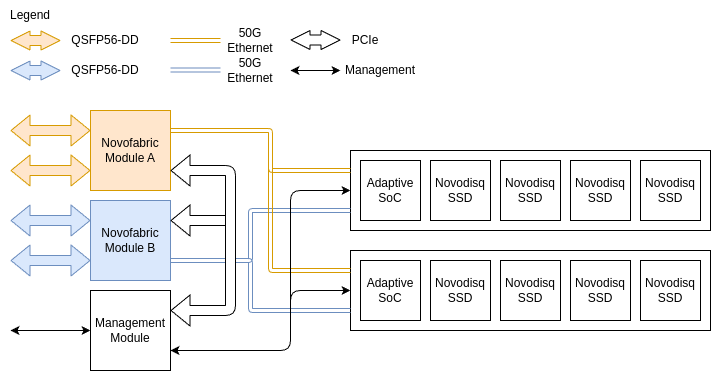

Supported Fabrics
| Protocol | Bandwidth* | Extensibility | Role |
|---|---|---|---|
| Ethernet | 2× 400G | Packet Engine | Network Attached Storage |
| CXL 3.1 | 2 × Gen6x8 | Memory Pooling or MH-SLD | Storage, Memory and Compute Pooling |
| InfiniBand | 2× 100G | None | RDMA Storage |
* Link Layer Bandwidth. Non-blocking throughput may vary depending on system configuration.
Use Case Scenarios
- Ethernet SDN Integrate with OpenvSwitch or 6WIND for programmable Ethernet fabrics. Deploy hardware offloaded packet forwarding, transformation and analysis pipelines.
- InfiniBand Gateway Access RDMA Novoblade storage and provide an IPoIB to Ethernet gateway for your HPC cluster.

- NVMe over Fabrics Controller Combine up to 10 Novoblades behind a single Novofabric module for high-bandwidth storage.
- CXL 3.1 Persistent Memory Combine up to 10 Novoblades behind a single Novofabric module for high-density persistent memory for HPC clusters.
- Heterogeneous Fabric Orchestration Dynamically map workloads across InfiniBand, CXL, and Ethernet domains. Span multiple enclosures as a coherent CXL 3.1 network.
Conclusion
Novodisq gives organisations a high-density, low-power platform that reduces the long-term cost of storing and moving data. It supports sovereign data lakes, large AI workloads, and distributed deployments from major data centres to regional and edge sites, all in one consistent architecture.
Novofabric modules allow Novoblade systems to slot into existing networks while also forming the base for new designs. They bring the flexibility to run multiple fabrics, adapt to new protocols over time, and support long operational lifecycles.
We welcome partners and customers to work with us as we continue to build out this platform and shape the next generation of data infrastructure.